

When Vibration Testing Is "To Be or Not To Be" for Your Product.
Overview of Key Industry Requirements (Automotive, Batteries, E commerce, Renewable Energy)
PUBLICATIONS
1/5/20264 min read
Until now, we have discussed why it is worth testing products for vibration to avoid complaints and build a strong brand. That is the domain of good engineering practice. However, there is a world where vibration testing is not an option. It is a hard requirement, a gatekeeper without which your product will not reach the market at all.
In many key sectors of the economy, resistance to vibration is synonymous with public safety or critical business reliability. In these industries, no one takes the word or declaration of a manufacturer at face value. They demand hard evidence in the form of a report from a professional and independent laboratory.
If you operate in the battery, automotive, renewable energy, or e commerce sectors, ignoring these standards is not a risky strategy: it is a guarantee of failure.
Here is an overview of sectors where the vibration table (shaker) is a mandatory stop on the way to the customer.
1. Transport of Lithium Batteries. A Ticking Bomb in a Container
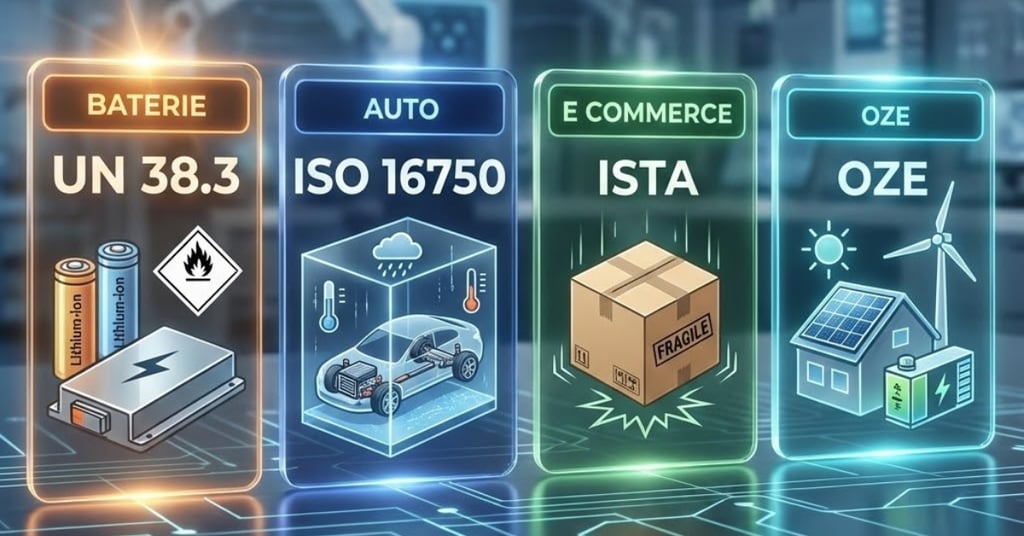
This is currently one of the hottest topics in international logistics. If you produce, import, or integrate batteries or devices powered by lithium ion batteries (from powerbanks to ebikes and energy storage systems), you must know this acronym: UN 38.3.
Why must you do this?
Lithium batteries are classified as dangerous goods in every mode of transport: land, air, and sea. An internally damaged battery can undergo autoignition, and a lithium fire on board a cargo plane or container ship is extremely difficult to extinguish. Vibrations during transport are one of the primary risk factors.
UN 38.3 (Manual of Tests and Criteria)
To legally ship a battery, it must pass a series of tests described in the UN manual. One of the most important is Test T3 (Vibration), which simulates brutal transport conditions.
You need a report confirming the successful completion of UN 38.3 procedures. Without this document, no serious forwarder will accept your goods on board. Your container will get stuck in the port, and your supply chain will be broken.
2. Automotive. An Extreme Training Ground Under the Hood
The automotive industry is the Champions League of reliability. Here, an electronic component is expected to withstand 10 to 15 years of operation in conditions that would kill ordinary electronics in a week.
Why must you do this? (OEM Contractual Requirement)
Car corporations (such as VW, BMW, or Toyota) shift the responsibility for quality onto suppliers. If you want to sell them your part, you must prove its armored durability in controlled conditions. The costs of a potential service recall go into millions of euros, so no one will take the risk of purchasing an unverified component.
ISO 16750 3 and Corporate Standards
The ISO 16750 3 standard (Mechanical loads) defines rigorous vibration profiles depending on the installation location, such as the engine, bodywork, or suspension. In addition to ISO, every major manufacturer has its own specific requirements.
Lack of qualification for the supply chain. Even if your product is innovative, without reliable vibration test results conducted on professional equipment, you will not enter the OEM market.
3. Renewable Energy. An Investment for Decades
The renewable energy sector is critical infrastructure designed for 20 to 25 years of field operation, often in extreme weather conditions.
Why must you do this?
Investors and banks financing the construction of a solar or wind farm demand guarantees that the components used (inverters, trackers, or energy storage) will not fail after a few years. Reliable environmental testing is a condition for the so called bankability of a project.
Main Vibration Challenges in Renewable Energy:
Transport of heavy components over rough terrain, constant vibrations from wind (material fatigue), and in some regions, seismic requirements.
IEC 60068 Standard and Others
Power electronic devices in the renewable energy sector are often tested according to the IEC 60068 series (environmental tests) and product standards such as IEC 62619 for energy storage, which contain rigorous mechanical test procedures.
Product rejection by the general contractor (EPC) or investor. Risk of giant contractual penalties for downtime if a key component fails as a result of material fatigue in the field.
4. Ecommerce and Logistics. Surviving the Last Mile
E-commerce giants know exactly how much returns of damaged goods cost them (DOA: Dead On Arrival).
Why must you do this?
To limit losses, large platforms demand proof from suppliers that the product and its packaging can survive the brutal reality of modern logistics: being dropped in sorting centers and riding in a bouncing courier van.
ISTA Standard (International Safe Transit Association)
Many logistics programs require packaging verification according to ISTA procedures (for example, ISTA 3A). These tests include random vibration sequences simulating road and air transport combined with drop tests.
Penalties from the platform, forced repackaging of goods, or a block on the seller account. A positive test result according to the ISTA procedure is a passport to trusted supplier status.
Do Not Guess Which Standard Applies to You
In the maze of ISO, IEC, EN, UN, and ISTA standards, it is easy to get lost. An error in selecting the standard can be expensive.
At DLP Compliance Services, we have the knowledge and equipment to conduct these key tests in accordance with the requirements of your industry standards, whether for automotive, batteries, or renewable energy.
We provide you with reliable engineering data that gives you the confidence that your product is market ready. Do not risk a sales block or rejection in a tender. Contact us and verify the durability of your product in a professional laboratory.
Contact
+48 32 49 44 305
© 2025 DLP SP. Z O.O.


office@dlp-poland.com

ul. G. Morcinka 7D, 43-417 Kaczyce