


Vibration Testing Is an Investment in Reliability. Not Just a Requirement
Vibration is the Silent Killer of Your Product and Your Reputation.
PUBLICATIONS
12/10/20256 min read
Your R&D team spent months designing a new electronic device. The prototype on the desk works flawlessly. The software is stable; the features meet all expectations. You proudly ship the first batch to distributors.
Three months later, the nightmare begins. Your complaints department is flooded with tickets: "The device won't turn on after shipping," "The display flickers during machine operation," "There's a loose part rattling inside."
What went wrong? The product was great "on paper," but it wasn't ready for a collision with reality.
The Invisible Enemy at Every Stage
Vibration is the silent killer of products. It is an invisible yet relentless enemy that attacks your hardware at every stage of its lifecycle:
During weeks of transport in a shipping container and on a pallet in a bouncing truck.
During brutal handling and sorting in logistics hubs (the so-called "last mile").
During years of operation on a factory floor, where constant vibrations are generated by neighboring heavy machinery.
Li-Ion Batteries and the Specter of Fire
While cracked plastic on a TV casing is "merely" an expensive warranty claim, vibration damage to a battery is a potential catastrophe.
A lithium-ion (Li-Ion) battery is not just an ordinary component, it is a complex, energy-dense chemical system. Inside every cell are ultra-thin, delicate separators that keep the positive electrode apart from the negative one.
Long-duration transport vibrations or severe shocks can lead to the physical abrasion, puncture, or displacement of these separators.
The Result? An internal short circuit. This is a direct path to an uncontrolled, rapid temperature increase (known as thermal runaway), and consequently, to the self-ignition or explosion of the battery, which is extremely difficult to extinguish.
The Problem of "Cheap Substitutes" from Asia
Unfortunately, we are observing a very dangerous trend on the market, particularly in e-commerce. Many cheap batteries, battery packs, or devices with built-in power sources (e.g., power banks, toys, cheap e-scooters) imported from Asia pass absolutely no rigorous vibration tests.
Their manufacturers cut costs by deliberately skipping this key stage of safety verification. They often provide importers with unreliable documentation or certificates that have no basis in real-world testing.
By introducing such untested products onto the EU or US market, the importer assumes enormous risk, not only financial (returns, market recalls) but also legal liabilities related to end-user safety.
Accumulated Stress
Do you know how much every warranty claim caused by a cracked solder joint or a dangerous battery actually costs you?
The goal of professional vibration testing is to simulate and accumulate this multi-year environmental stress into a few intense hours in the laboratory. It is the only way to detect a critical flaw before your customer (or customs authorities) does, and before you pay for it with your reputation.
Why Testing is Savings, Not a Cost
Many managers look at the cost of renting a lab and think: "Do we really need this? The prototype works." This is short-sighted thinking. Vibration testing is not a cost; it is an investment in risk reduction.
The Golden Rule of Quality: The 1-10-100 Rule
In quality engineering and production management, the "Rule of Ten" is well known. It illustrates how the cost of fixing a defect grows exponentially depending on the stage at which it is detected:
Cost of 1: Detecting and fixing a design error at the design/prototype stage (e.g., during vibration tests at the DLP lab). The cost is minimal, a CAD drawing change, improving the soldering process, adding a support bracket.
Cost of 10: Detecting a defect at the mass production stage. You have to stop the line, modify expensive tooling, and perhaps scrap an entire batch of material.
Cost of 100 (or more!): Detection of the defect by the customer in the market. The costs are astronomical: reverse logistics, mass service repairs, product replacements, B2B contractual penalties, and above all, a permanent loss of trust and negative reviews online, which are impossible to put a price on.
Vibration testing allows you to stay at the safe "Cost of 1" level. It is an insurance policy that protects your business from the catastrophic "Cost of 100" scenario.
The Anatomy of Failure. What Physically Happens to the Product?
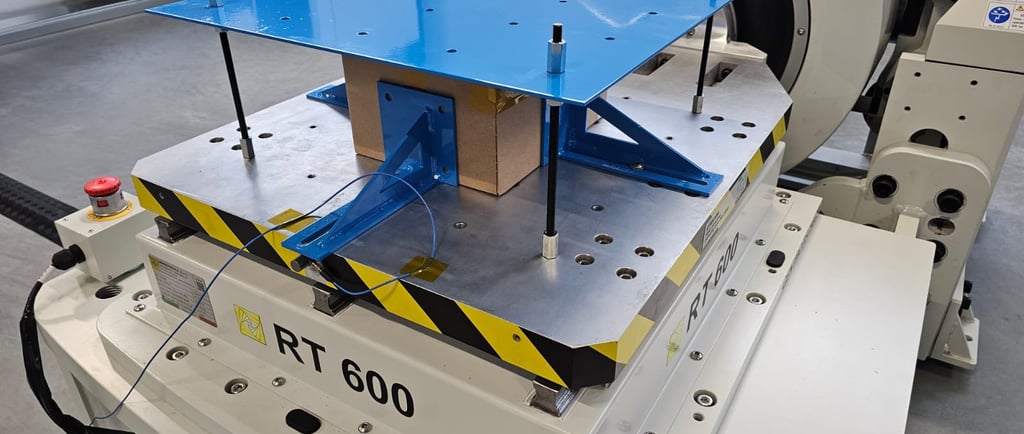
Vibration testing is not mindless "shaking" of a product on a table. It is a precise engineering diagnosis aimed at exposing structural weak points.
Here are the three main enemies we look for and eliminate in the lab:
A. Resonance. The "Glass Trap" of Your Design
Every object has its own "natural frequency" at which it "likes" to vibrate. If external vibrations (e.g., from a car engine or production machinery) perfectly match this frequency, the phenomenon of resonance occurs.
What does this mean? The amplitude of vibration increases dramatically, even with minimal input force. It’s like pushing a child on a swing at exactly the right moment, the swing goes higher and higher.
The Result in the Product: A massive element (e.g., a heavy heatsink, large capacitor, or transformer) on a PCB enters resonance and rips out of its mounts with tremendous force, destroying delicate traces and causing permanent failure. Sinusoidal tests are specifically used to "catch" these dangerous frequencies.
B. Material Fatigue – Death by a Thousand Cuts
This is an insidious process because it is not immediately visible. It’s not about one strong impact, but millions of tiny stress cycles (bending, stretching) resulting from continuous, random vibrations (e.g., during long road transport).
The Result in the Product: Micro-cracks form in the metal structure (e.g., in the leg of an electronic component, in a solder joint, or in an aluminum battery holder). With each subsequent vibration cycle, the cracks enlarge until finally, the element snaps completely, often only after several months of use by the customer.
C. Contact Failure and Loosening (Fretting)
Vibrations cause elements that are in contact with each other to micro-shift relative to one another.
The Result in the Product: Screws and nuts vibrate loose (if they haven't been properly secured with threadlocker or a lock washer). Electrical connections, plugs, and connectors "wear out," losing stable contact. This leads to intermittent device operation, data transmission errors, arcing, or dangerous overheating of high-current contacts.
When Saving on Tests Costs a Fortune
These scenarios are not theoretical. They are the painful reality for many companies that skipped the environmental verification stage.
Consumer Electronics and the "Courier Effect" (DOA)
Product: A new line of smart home controllers sold via e-commerce.
Error: The company only tested the devices stationarily on a desk. They deliberately assumed standard shipping packaging would be sufficient.
Result: During road transport (random vibration + shock during handling), a heavy power supply module inside the device, which was secured too weakly (only at two solder points), began to vibrate. Fatigue stresses led to solder joint fractures.
Cost: 15% of devices from the first batch (5,000 units) arrived at customers Dead On Arrival (DOA). The cost of the mass recall, reverse logistics, and device replacements exceeded the company's annual R&D budget, and the brand garnered terrible reviews.
Industry and Costly Downtime
Product: An industrial sensor mounted on a large vibrating machine (e.g., a crusher, shaker screen).
Error: The manufacturer did not verify the sensor's resistance to the specific vibration spectrum of the target machine.
Result: An internal flexible connector in the sensor went into resonance at the machine's standard operating speed. After just 2 weeks of operation, the connector snapped, halting the end customer's entire production line.
Cost: Contractual penalties for the client's production line downtime were many times higher than the value of the sensor itself. The company lost a key B2B client.
Industry Applications and Safety Requirements. "Why You Must"
In many key industries, vibration testing is not just "good engineering practice," but a hard legal or contractual requirement, without which you cannot sell the product.
Lithium Battery Transport (A Key Legal Requirement)
Lithium-ion batteries are considered Dangerous Goods in logistics.
The Challenge: As described above, vibrations during air or sea transport must not damage internal separators and cause a short circuit, which could trigger a fire difficult to extinguish on board an aircraft or ship.
The Key Standard: UN 38.3 (Test T3: Vibration and T4: Shock). Without this certificate, no serious freight forwarder (air or sea) will accept your batteries for transport. It is a "make or break" factor for legal export.
Automotive Industry
A car is one of the toughest environments for electronics.
The Challenge: Simultaneous high-frequency vibrations from the engine and high-amplitude shocks from road irregularities, combined with extreme temperature changes (from -40°C in winter during startup, to +85°C or even +125°C under the hood in summer).
The Key Standard: The ISO 16750 series and OEM standards (e.g., VW 80000, BMW GS 95024). Every Electronic Control Unit (ECU), sensor, or lamp must pass rigorous, long-duration tests to guarantee 10–15 years of trouble-free operation in these conditions.
Electronics and E-commerce
Even if your product sits quietly on a desk, it must get there in one piece first.
The Challenge: The courier's "last mile," tossing packages in sorting hubs, driving a delivery van over potholes.
The Key Standard: Standards from the IEC 60068 series and packaging test standards (e.g., ISTA, required by Amazon, among others). These tests simulate the brutal reality of the supply chain, ensuring the product and its packaging are robust enough to avoid DOA returns.
Turn Weakness into Strength
Vibration testing is not a bureaucratic requirement to be "checked off." It is a powerful engineering tool that allows you to sleep soundly, knowing your product is ready for a collision with reality. It's the difference between a brand that "sort of works" and a brand renowned for reliability.
Don't wait for the market and customers to verify your design. Do it in controlled laboratory conditions before it's too late.
Do you want to be sure that your product (especially a battery!) will survive transport and years of operation?
Don't guess. Test. Contact the experts at DLP Sp. z o.o. We will help you select the appropriate vibration test profile, identify structural weak points, and introduce your product to the market with full confidence in its quality and safety.
Contact
+48 32 49 44 305
© 2025 DLP SP. Z O.O.


office@dlp-poland.com

ul. G. Morcinka 7D, 43-417 Kaczyce