

UN ECE Homologation – What It Is and When It Is Needed
UN ECE homologation is more than just a certificate. Find out what the UN regulations system is, how it works in Poland, and how vehicle homologation differs from component homologation.
PUBLICATIONS
7/6/20265 min read
UN ECE Homologation – why is it more than just a document?
How to obtain a homologation certificate? This is a question on the minds of many entrepreneurs and engineers. The problem is that UN ECE homologation is not a single stamp that automatically settles the matter. It is an extensive, international regulatory system, and a lack of understanding of how it works is the first step toward design and legal errors. We explain where this system originated, how it relates to Polish regulations, and why vehicle homologation and the homologation of its parts are two different procedural paths.
The term UN ECE homologation is sometimes used as a shorthand, as if it referred to a single document or procedure. In reality, however, we are talking about an extensive system originating from the Geneva Agreement of March 20, 1958. Within its framework, UN Regulations are created for wheeled vehicles, equipment, and parts. They also define the conditions for the mutual recognition of homologations by different countries. This is not, however, a mere historical curiosity. The current shape of the system is the result of a multi-year evolution of automotive technology, and the document itself functions today as the updated Revision 3.
What is UN ECE homologation in practice
A regulatory system, not a single formality.
It should be kept in mind that UN ECE homologation is not a "stamp" for everything. It is a system based on technical regulations that apply to specific categories of products and specific requirements. The Agreement itself mentions wheeled vehicles, equipment, and parts, which shows from the very beginning that the scope is not limited solely to the complete vehicle.
Asking the question "does my product require homologation?" is just the beginning; the key should be to determine exactly what is to be the subject of assessment:
Is it:
a complete vehicle,
a specific component,
a piece of equipment,
a separate technical unit?
It is precisely from this correct classification that the proper procedural path begins.
Why homologation even exists
Safety, uniform requirements and reduced trade barriers
Several functions lie at the core of the homologation system simultaneously. Revision 3 of the Agreement explicitly points to the need to reduce technical barriers in international trade through the application of harmonized technical regulations, but at the same time emphasizes the importance of safety, environmental protection, energy efficiency, and measures against the unauthorized use of vehicles.
In practice, this means that homologation plays a dual role. On the one hand, it aims to protect the user and the environment by imposing common technical requirements. On the other hand, it is designed to facilitate the functioning of the market, because if a given Contracting Party applies a specific regulation, the system provides for the recognition of homologations granted in accordance with that regulation by other competent authorities applying the same framework.
Market unification without blurring responsibility
It is worth noting here that the logic of the system is not limited solely to facilitating sales. Homologation also structures technical responsibility, clearly indicating according to which requirements a given product type is to be evaluated, what conditions it must meet, and to what extent a given approval can be recognized by other parties to the system.
Therefore, homologation remains one of the fundamental tools for organizing the automotive market. It does not replace the design process or the manufacturer's responsibility, but it creates a common framework in which technical compliance ceases to be merely a declaration and becomes an element of a formally structured system.
How does it work in Poland? The Road Traffic Act and the new 2023 Act
In Poland, we must take a two-track approach to the subject of admitting automotive products to the market, which is clearly defined by:
The Road Traffic Act of June 20, 1997. This is the absolute foundation for general traffic rules and the admission of vehicles.
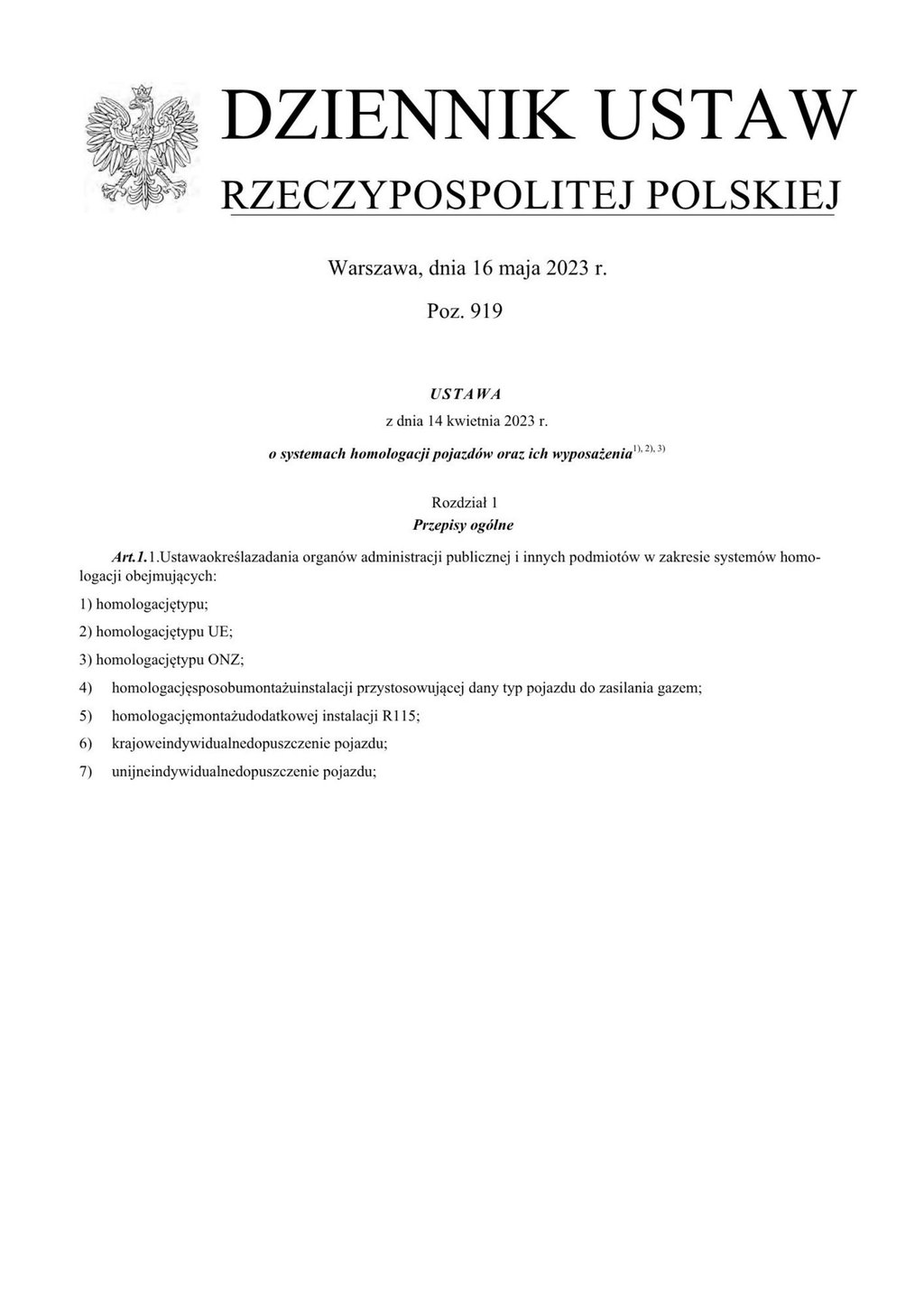
The Act on the homologation systems for vehicles and their equipment of April 14, 2023. It has been in force since July 1, 2023, and structures the homologation system as a separate, specialized regulatory area.
Importantly, the latest 2024 update to the Road Traffic Act explicitly incorporates the changes introduced by the new 2023 act. This means that for every project, we must analyze the general road traffic context in combination with the highly detailed, sector-specific homologation regime.
In practice, this means that when analyzing a project, a general reference to the Road Traffic Act is not enough. For homologation issues, it is also necessary to consider the sectoral act that structures the vehicle and equipment homologation system itself in Poland.
Therefore, it is worth analyzing homologation as an element of the international UN system and the national legal framework that determines how this system functions in Poland.
Vehicle homologation vs. component homologation
There are two different approaches
The most costly mistake is equating the homologation of an entire vehicle with the homologation of a single component. The UN system clearly differentiates these categories into vehicles, equipment, and parts.
Vehicle homologation: Applies to the complete vehicle type as a coherent whole. According to Revision 3, it incorporates the relevant partial homologations obtained under UN regulations.
Component homologation: Refers, for example, to a specific product such as a headlight or braking system, which, if the relevant regulation provides for it, can be assessed independently of the machine in which it will ultimately be installed.
This distinction dictates the method of compiling documentation, the selection of the legal regime, and the definition of the subject of assessment itself.
In the era of modern automotive technology, where a vehicle is a network of complex subsystems, this differentiation is absolutely crucial, and although these are two separate paths, in practice they can intertwine.
How many UN ECE regulations are there
The scale of the system
UN ECE homologation is not based on a few single acts. The UNECE itself publishes addenda to the 1958 Agreement in blocks numbered from 0–20 up to 161–180, which very well demonstrates the scale of the entire set of regulations and the fact that the system covers a very large number of areas concerning vehicles, parts, and equipment.
This is precisely why homologation is sometimes perceived as a complex topic within the industry. This does not stem from a single difficult definition, but rather from the fact that we are dealing with a broad system of technical regulations, the application of which depends on the product category, its intended use, and the scope of the assessment.
UN ECE homologation is not a single "piece of paper," but an international regulatory system rooted in the 1958 Geneva Agreement. Its purpose is simultaneously safety, the harmonization of technical requirements, the facilitation of international trade, and the mutual recognition of homologations granted on the basis of common regulations.
In Poland, the topic should be read in conjunction with the Road Traffic Act, but also with the separate act on the homologation systems for vehicles and their equipment, in force since July 1, 2023. It should also be remembered that on a practical level, the distinction between whole-vehicle homologation and the homologation of a component, part, or equipment is crucial, because this is exactly where the correct classification of the subsequent procedural path begins.
Are you facing a homologation challenge in your project?
Before you start working, establish three things:
1. What exactly will you be homologating (the entire vehicle or a part)?
2. Which legal act defines the path in Poland?
3. Which UN ECE regulation covers your product?
Useful sources and legal acts:
Contact
+48 32 49 44 305
© 2025 DLP SP. Z O.O.


office@dlp-poland.com

ul. G. Morcinka 7D, 43-417 Kaczyce