

The War for Megawatts: How the Battery Arms Race is Shaping Our Future
Let's try to imagine just a single day without batteries. Our smartphones instantly turn into useless bricks of glass and metal, laptops go dark, and city streets fall silent, stripped of modern electric cars, hybrids, and even urban e-scooters. The truth is brutally simple. The modern world is entirely dependent on portable energy. Whoever controls the most efficient ways of storing it holds the keys to the technological and economic future of the globe.
3/16/20265 min read
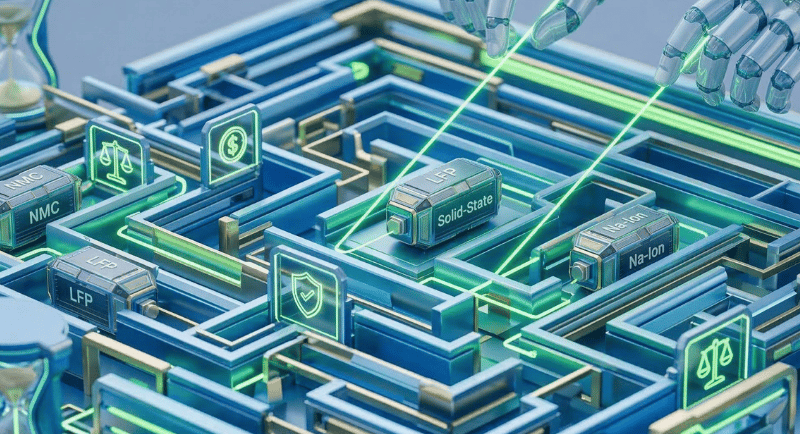
We are currently at a fascinating yet critical juncture. On one hand, our appetites are growing at a breakneck pace; we expect devices that last many times longer and cars capable of covering enormous distances. On the other hand, we are painfully colliding with the chemical limitations of today's technologies. Long charging times, a drop in performance during winter, the risk of fire, and the still-gigantic weight of cells are problems that form the bottleneck of our civilization.
These limitations have sparked the greatest arms race of the 21st century. A ruthless battle is unfolding in laboratories and gigafactories. Tech titans are pumping billions of dollars into research, governments are fighting for access to rare minerals, and industrial spies are hunting for patents. The stakes in this game are total dominance in the new energy market.
The Kings of the Current Market and the Pragmatic Chassis Revolution
Before we look to the future, we must understand what is happening here and now. The current power supply market is evolving faster than ever, and today’s engineers are driven by pure pragmatism, escaping expensive raw materials and changing the very architecture of vehicles.
Lithium-Ion Batteries with NMC Chemistry:
Powerful, but Fading into the Shadows For years, they formed the absolute foundation of electromobility. Today, however, the automotive industry is clearly beginning to turn away from this technology. At their core are electrodes between which lithium ions travel, immersed in a flammable, liquid electrolyte. The production of NMC cells utilizes expensive elements that are highly problematic from a global supply chain perspective: nickel, manganese, and the controversial cobalt.
Performance vs. Costs
Their greatest advantage is massive energy density, which is why we still find them in models where squeezing maximum range out of every kilogram of battery is the priority. However, the market is mass-migrating away from this chemistry; manufacturers are looking for cheaper and safer alternatives at every price point.
Physical Barriers
Charging a liquid electrolyte too quickly generates enormous amounts of heat and degrades the cell. In the event of physical damage, there is a risk of a thermal runaway (a highly uncontrollable chain reaction of heat build-up).
LFP Batteries and the LMFP Evolution.
The Pragmatic Workhorse Shows Its Teeth The absence of cobalt and nickel, bulletproof safety, and resistance to degradation have made LFP (Lithium Iron Phosphate) technology a global standard for players like Tesla and BYD. However, because LFP is heavier than NMC, engineers introduced a brilliant compromise: LMFP (Lithium Manganese Iron Phosphate). The addition of manganese allows for a 15–20% higher energy density while maintaining low costs and a high level of safety. It is precisely LMFP that is now stepping into the space vacated by expensive NMC in mid-range cars.
Cell-to-Pack (CtP) The biggest change, however, is happening outside of the chemistry itself. The industry is moving away from building batteries like "Russian nesting dolls" (cell inside a module, module inside a pack). In Cell-to-Pack or Cell-to-Chassis systems, the cells are mounted directly into the floorboard. The battery ceases to be mere ballast and becomes an integral element stiffening the car's body. This saves precious kilograms and allows more energy to be packed into the same space.
Between Laboratory Vision and Market Implementation
While traditional cells undergo optimization, intensive tests of solid-state electrolyte technology are underway in laboratories. It must be clearly stated, however, that at this stage we do not know for sure if and when this technology will enter mass, cost-effective production. Instead of declaring an imminent revolution, the market is very carefully observing this work, eagerly awaiting results that could completely change the trajectory of electromobility and other sectors relying on energy storage.
Solid-State Batteries (SSB): A Holy Grail with Hurdles
Replacing flammable liquid with a solid material eliminates the risk of fire and promises a drastic leap in energy density. The road to the market is bumpy, though, and engineers must overcome massive problems:
Low ionic conductivity in sub-zero temperatures.
Cracking of the solid electrolyte under load and contact issues at the lithium-electrolyte interface.
The necessity to maintain extremely high pressure inside the cell.
Samsung's Breakthrough: The Silver Shield (Ag-C)
One of the problems with SSBs was the formation of destructive dendrites. Samsung developed a silver-carbon (Ag-C) composite anode, where an ultrathin layer of silver effectively blocks this process. Here, however, we must separate laboratory PR from reality. Ranges of 1,000 km are the results of early tests. In the first generation of any potential production SSB batteries for EVs, we expect excellent but realistic parameters: an energy density of around 450–550 Wh/kg and fast charging in 15–20 minutes.
Sodium-Ion Batteries (Na-Ion): Salt of the Earth.
For budget segments, technology based on widespread and absurdly cheap sodium is being developed. These batteries handle freezing temperatures exceptionally well, but their low energy density disqualifies them from higher-class cars. Their natural habitat will be:
Stationary Energy Storage Systems (ESS).
Small A- and B-segment cars, light commercial vehicles, forklifts, golf carts, and municipal vehicles.
Costs and Raw Materials, or the Dark Side of the Revolution
The energy transition is a massive extractive industry with bottlenecks. We are talking about the controversial mining of cobalt in the Democratic Republic of Congo, environmental degradation during lithium extraction, and China's dominance in raw material refining.
Silver Collides with Economies of Scale In the context of Samsung's breakthrough batteries (Ag-C), a frequently repeated myth is the requirement of 1 kilogram of silver per car. In reality, we are talking about micrometer-thick coatings, which translates to consumption measured in grams. This doesn't change the fact that these grams, multiplied by millions of cars in potential mass production, would still trigger a shockwave in the global silver market, hitting the electronics and photovoltaics industries.
The Barrier to Entry and Salvation in Recycling Due to the high costs of the new technology and the use of precious metals, Solid-State batteries, if they enter use, will debut exclusively in premium cars. The salvation for profitability will be recycling; we are able to recover silver with an efficiency exceeding 95%. After years of operation, depleted battery packs will literally become urban mines of raw materials.
The Race of Tech Titans
Building market power requires billions of dollars, which drastically changes the map of global influence:
Chinese companies CATL and BYD are the kings of mass production. BYD are the masters of vertical integration, while CATL supplies the lion's share of Western automotive brands. Right behind them are the veterans from Korea (LGES, Samsung SDI) and Japan (Panasonic).
The USA is pumping billions into local supply chains, promoting new cell and vehicle architecture. Europe is fighting for independence (e.g., Sweden's Northvolt) but constantly clashes with bureaucracy and energy costs.
Toyota currently holds the most patents worldwide for Solid-State technology. If their engineers manage to overcome the physical obstacles, the Japanese could radically shift the balance of power in the future.
The market in the coming decade will undergo strong polarization. On one hand, we will witness a pragmatic, mass electrification. Engineers have stopped fighting for record-breaking capacities and have focused on optimized architecture (Cell-to-Pack) and cheap, safe chemistries like LMFP or sodium.
On the other hand, the entire industry is looking toward laboratories working on solid-state cells with attention and a large dose of caution. If Solid-State technology and innovations like Samsung's silver shield ultimately debut on the roads, they could render today's limitations obsolete and reshuffle the balance of power, offering unprecedented safety for the premium segment.
The race for what lies beneath the floor of our car has entered its mature phase. The winner will be the one who balances innovation with engineering realities and ruthless market economics.
Contact
+48 32 49 44 305
© 2025 DLP SP. Z O.O.


office@dlp-poland.com

ul. G. Morcinka 7D, 43-417 Kaczyce