


The Fastest-Growing Market in the EU. How Polish BESS Investments are Driving the Energy Transition in 2026?
Large-scale energy storage drives Poland's transition. Learn about 2026 BESS leaders, the EU Battery Regulation, and crucial certification requirements
PUBLICATIONS
3/31/20269 min read
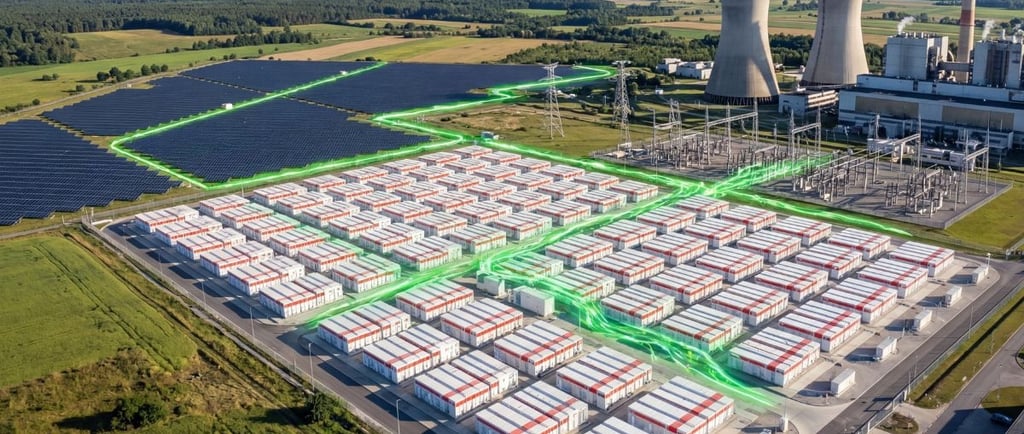
The Polish energy transition has long ceased to be merely a theoretical plan on paper. In 2026, we are at the very center of a revolution, breaking new records in solar and wind power generation. However, this massive success of the Polish RES sector has brought with it an equally massive technological challenge.
The phenomenon of energy oversupply on sunny, windy days and its drastic shortage in the evenings has become an everyday reality. Polskie Sieci Elektroenergetyczne (the Polish transmission system operator) are increasingly faced with the necessity of emergency generation curtailment, disconnecting photovoltaic farms to save the stability of the National Power System.
The answer to this problem is large-scale and commercial BESS (Battery Energy Storage Systems). They have ceased to be an innovative curiosity and have become the absolute foundation of the country's energy security. Most importantly, in this technological arms race, Poland is no longer just a passive observer. We have become the European leader in growth dynamics, a market that not only implements these solutions en masse, but largely designs, develops, and manufactures them itself.
The scale of the BESS boom in Poland
The current year is a time of unprecedented investment acceleration. The energy storage market in Poland has transitioned from the pilot phase to a phase of massive commercialization. We are no longer talking about tests, but about breaking ground for projects of strategic importance to the entire country.
Investment explosion and multi-billion state support.
The market is driven by a massive stream of capital. The key catalyst turned out to be the program of the National Fund for Environmental Protection and Water Management (NFOŚiGW), supported by the Modernisation Fund. The funding pool amounts to a staggering PLN 4 billion in non-refundable subsidies dedicated exclusively to large-scale energy storage facilities.
The co-financing covers up to 45% (and in the case of smaller entities even up to 65%) of the eligible costs for the construction of storage facilities and the necessary connection infrastructure.
The condition for participating in the program is the construction of an installation with a minimum power of 2 MW and a capacity of at least 4 MWh. The government's goal is clear. The program is designed to generate the connection of storage facilities with a total capacity of at least 2.5 GW to the Polish grid.
The momentum of Polish energy groups and private investors.
When we look at the investment map, it is clear that we are building facilities on a European scale. PGE is the leader here, but private capital is not lagging behind:
Żarnowiec (PGE Group): This is currently the most advanced and largest undertaking of this type in Poland, the construction of which is already underway. It is being built right next to the country's largest pumped-storage power plant, Żarnowiec (716 MW). The combination of these two technologies will create a unique hybrid energy hub with enormous regulatory capabilities. The designed storage facility is to have a target power of up to 263 MW and a capacity of approximately 981 MWh. The project, worth approx. PLN 1.5 billion, is being executed by LG Energy Solution Wrocław, and the batteries themselves will be manufactured in Poland. Commissioning is scheduled for the second quarter of 2027. The main task of the investment will be balancing energy from offshore wind farms in the Baltic Sea as well as large onshore wind and solar farms.
Gryfino / Dolna Odra (PGE Group): This is PGE's second key investment in large-scale energy storage, alongside Żarnowiec. The target power of the storage facility is to be up to 400 MW, and its minimum capacity is 800 MWh, with some analyses indicating the potential for expansion up to 1600 MWh. The location in the West Pomeranian Voivodeship is extremely strategic due to the highest concentration of onshore wind farms in Poland and the proximity of planned offshore farms. The storage facility is intended to stabilize this massive "green" energy hub. In August 2025, PGE Energia Odnawialna announced a tender for the design and construction of the installation, and the launch itself is scheduled for 2029. Importantly, the project already holds a 17-year capacity market contract, which ensures its absolute financial stability upon launch.
Szprotawa and offshore wind farms (Polenergia): The largest Polish private energy group is actively building its own portfolio of storage facilities to support its wind and photovoltaic farms. In January 2026, a Polenergia subsidiary signed an agreement with NFOŚiGW for PLN 43.88 million in co-financing for the construction of a 50 MW battery storage facility in Szprotawa. The company, together with Norway's Equinor, is also developing offshore wind farm projects in the Baltic Sea (Bałtyk I, II, and III), for which the construction of energy storage is a key element of the supply stabilization strategy. Polenergia regularly participates in capacity market auctions, which allows it to secure revenues for planned storage units, making them profitable even before full launch.
Trzebinia (DRI / DTEK Group): Private investors are also playing in the top league. In Trzebinia in southern Poland, a massive storage facility with a power of 133 MW and a capacity of 532 MWh is being built, the cost of which is estimated at one billion PLN. Although the project was initially developed by Columbus Energy, its sale to DRI, a company belonging to the Ukrainian energy group DTEK, was finalized in 2024 (for approximately EUR 30 million). The project already has grid connection conditions and a winning contract in the capacity market auction, making it one of the largest private storage facilities in this part of Europe. The investment arouses emotions among residents due to its scale, but it is crucial for stabilizing the southern energy hub of Poland.
These projects are located exactly where the PSE operator has the biggest problems balancing local production from solar and wind farms.
Green light in regulations – what was actually facilitated?
Simply throwing money at it is not enough. The real "game changer" turned out to be precise changes in the Energy Law and the Construction Law, which removed legislative obstacles from investors' paths:
Cable pooling (Sharing the grid connection): This is the most important revolution. Previously, every facility had to have its own connection conditions, which operators were massively refusing due to a lack of grid capacity. Today, the law allows a wind farm, a photovoltaic installation, and an energy storage facility to be connected to a single connection point. Because the sun shines during the day, the wind blows at night, and the storage buffers the surpluses, these installations do not overlap at the same time. This drastically cuts investment costs.
Abolition of tariff absurdities (double charging): In the past, an energy storage facility, while charging from the grid, was treated by law as an end consumer and had to pay full distribution fees, and when discharging energy - as a generator. The law eliminated this double charging, which finally made price arbitrage, buying energy when it's cheap and selling it when it's expensive, commercially viable.
Legalization of the direct line: Regulations have finally made it easier for large Polish industrial plants to build their own RES farms and energy storage facilities behind the factory fence, connecting them with a cable directly to the production hall, completely bypassing the public distribution grid.
Capacity Market: Admission of energy storage facilities to Capacity Market auctions. Thanks to this, an investor building a large battery receives guaranteed, multi-million annual remuneration from the state for the very fact of being in "readiness" to supply energy to the grid in critical moments.
The Polish DNA of the transition. We are at the forefront of the European BESS peloton.
Looking at the current development of the energy storage market, Poland has no reason to have any complexes. We are at the very center of a technological revolution and have firmly moved to the front of the European peloton in the battery sector. Poland is emerging as an absolute leader in Europe when it comes to the production and export volume of lithium-ion systems. However, most importantly in the context of gigantic RES investments, we are not just Europe's "assembly plant". Polish engineering thought, our R&D departments, and domestic manufacturers play a key role in the design and construction of large-scale BESS storage facilities.
Who then is actually driving and executing these multi-billion investments in our country? Domestic manufacturers and electrical engineering giants with their own R&D.
The Polish market relies on strong, domestic players who are investing massive funds into their own laboratories, software, and production lines. "Made in Poland" batteries and BESS containers are today a synonym for the highest quality:
Wamtechnik: Located in Piaseczno, the company is an absolute veteran with over 30 years of experience and one of the leading European battery pack assemblers. Possessing its own advanced Research and Development department, Polish engineers from Wamtechnik design and manufacture dedicated, reliable energy storage systems (e.g., in the safest Li-FePO4 technology), serving the most demanding industrial applications.
BMZ Poland: Located in Gliwice, the factory is another powerful pillar of the Polish ecosystem. From here, intelligent power backup systems, advanced lithium-ion packs, and energy storage solutions dedicated to both the commercial (C&I) sector and large-scale power generation are shipped across Europe.
Impact Clean Power Technology (ICPT): The true pride of the Polish sector. The state-of-the-art GigafactoryX launched in Pruszków is a facility whose automated production challenges global players. Impact delivers advanced, scalable stationary energy storage systems for RES and industry, relying on its own rigorously tested battery packs.
ZPUE S.A. and Apator Group: Polish giants who have been electrifying our country for years have perfectly capitalized on the RES boom. They offer fully Polish, containerized transformer stations integrated with massive energy storage systems and advanced grid automation layouts that serve as the technological "brain" of the installations stabilizing the largest solar farms in Poland.
The strength of Polish integrators and EPC companies A 100 MW energy storage facility is a massive civil and electrical engineering infrastructure. This is where Polish engineering firms step in:
Companies such as ONDE, Electrum, or construction groups from the energy sector are responsible for executing turnkey projects. They design high-voltage connections, erect transformer stations, and physically integrate battery blocks with the National Power System.
We also have an outpouring of highly innovative Polish technology companies. They create proprietary EMS (Energy Management Systems) based on algorithms that decide in which exact second the storage should buy cheap power from the exchange, and when to feed it back into the grid. Many Polish integrators purchase base components from foreign suppliers to build, on their basis, complete, proprietary energy storage solutions under their own brand, perfectly tailored to the rigorous requirements of our grids.
An energy storage facility with a capacity of several dozen megawatt-hours is an object with an enormous concentration of chemical energy. Regardless of whether a Polish company builds the storage from scratch in its own factory or integrates imported modules under its own logo, it becomes the manufacturer in the eyes of the law. And this means the necessity of strictly meeting the toughest European standards before the device hits the grid.
Why does the Polish BESS boom require flawless compliance?
An energy storage facility with a capacity of several dozen megawatt-hours is a massive industrial installation with a gigantic concentration of chemical energy. For this dynamic market to grow stably, absolute safety and flawless regulatory compliance must be the foundation. Investors, banks financing these multi-billion projects, and insurance companies accept no compromises here.
Many Polish companies operate in an integrator model. They design their own management systems (EMS/BMS), but import the cell packs or ready-made modules themselves from global suppliers. It must be very clearly emphasized here that if a Polish company integrates foreign components and releases a finished large-scale energy storage product under its own brand, under EU law it becomes its manufacturer.
This means assuming 100% responsibility for fire safety, parameter stability, and the legality of placing the product on the market. It is the manufacturer with Polish capital that signs the EU Declaration of Conformity and affixes the CE mark. If a failure or a phenomenon of uncontrolled cell ignition occurs, the Polish entity is the one held responsible.
2026 Regulatory changes. What is the industry facing?
The year 2026 is a time when the law verifies the preparedness of companies. Introducing a large-scale industrial battery to the market and connecting it to the PSE grid requires navigating a thicket of rigorous requirements:
New EU Battery Regulation: The regulations have imposed drastic environmental and information requirements, including the need to implement a digital battery passport, calculate the carbon footprint, and demonstrate the share of recycled materials.
IEC 62619 Safety Standard: This is an absolutely crucial standard verifying the safety of lithium-ion batteries in industrial applications, protecting against, among other things, uncontrolled ignition during operation, the importance of which for the energy storage market we wrote about more extensively HERE.
UN 38.3 Transport Certification: This is the absolute foundation and a key standard required for the legal and safe transport of any battery system to the construction site.
EU Directives (LVD, EMC): The BESS storage must cooperate flawlessly with the Polish grid. This requires advanced testing under the Low Voltage Directive and electromagnetic compatibility.
Success requires a solid partner in certification
Today, Poland is setting the pace for the European energy transition, and our companies are proving that they can build world-class infrastructure. However, in an era of such complex regulations and a restrictive approach to safety, an excellent engineering design alone is no longer enough. Issues related to certification, documentation creation, and product legalization can be a bottleneck that delays the commissioning of investments worth millions of PLN.
That is why, as experts from DLP Sp. z o.o., we stand shoulder to shoulder with Polish manufacturers, importers, and integrators of BESS systems. We help in completing the technical documentation, guide you through the testing process (including UN 38.3, IEC 62619, and the requirements of the New EU Battery Regulation), and adapt products to rigorous European standards. We solve compliance issues, ensuring that your equipment is introduced to the market not only quickly but, above all, legally and 100% safely. Innovate, and we will make sure that your solutions reach the Polish grid without any obstacles.
Contact
+48 32 49 44 305
© 2025 DLP SP. Z O.O.


office@dlp-poland.com

ul. G. Morcinka 7D, 43-417 Kaczyce