


The Anatomy of Failure. What Really Happens to Your Product on the Shaker?
You’re looking at your new product. A solid casing, properly torqued screws, it looks rugged and ready for action. It feels like nothing could possibly damage it, right? That’s an illusion.
PUBLICATIONS
12/18/20253 min read
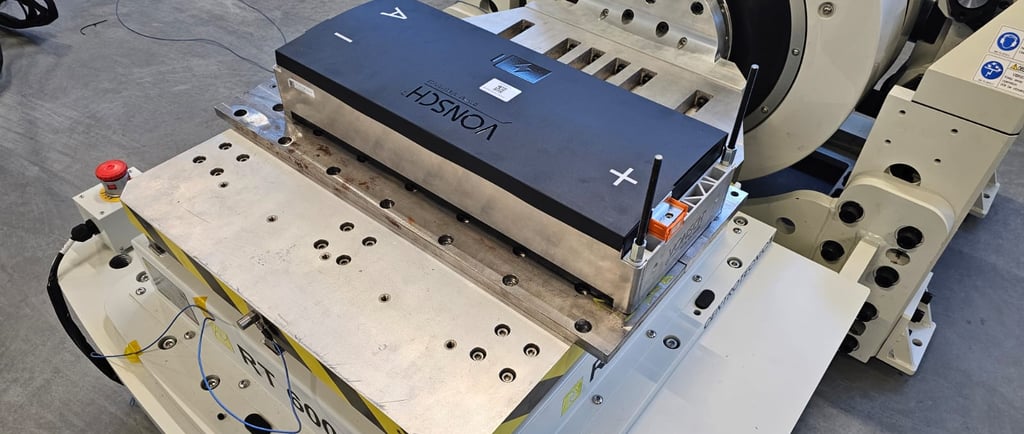
In the world of engineering, what "looks solid" to the human eye can, according to the laws of physics, be a structure riddled with weak points. It just takes the right kind of energy to expose them. That energy is vibration.
At DLP Certification, we witness firsthand how products designed for reliability succumb to the laws of physics on a daily basis. Today, we’ll take you behind the scenes of our lab and show you what really happens to your device when it hits a professional vibration table (commonly known as a shaker).
Here are the three main, invisible enemies of your design.
1. Resonance. The Invisible Destroyer of Your Design
This phenomenon is the number one cause of spectacular failures.
Every object in the universe, from a suspension bridge to a PCB in your device and the tiniest capacitor upon it, has its own "natural frequency." This is the frequency at which a given element "likes" to vibrate.
What happens in the lab? During a test (especially a sine sweep for resonance search), our shaker "scans" a wide range of frequencies. The moment external vibrations perfectly match the natural frequency of an element in your product, resonance occurs.
Every object in the universe, from a suspension bridge to a PCB in your device and the tiniest capacitor upon it, has its own "natural frequency." This is the frequency at which a given element "likes" to vibrate.
The Consequence for the Product: A massive element entering resonance (e.g., a heavy transformer or heatsink) acts like a jackhammer. It rips out of its mounts, tears traces on the PCB, or strikes adjacent components. This is often the end of the device.
2. Material Fatigue. Death by a Thousand Cuts
If resonance is a sudden blow, material fatigue is slow torture. It’s an insidious process because it remains invisible to the naked eye for a long time.
It’s not about one single massive overload, but millions of tiny stress cycles, bending and stretching, that occur during long-haul transport (e.g., random vibration in a truck) or machine operation.
What happens in the lab? We simulate years of operation in just a few hours. We subject the product to intense vibrations that accelerate aging processes.
The Consequence for the Product: Micro-cracks form in the metal structure, for example, in the lead of a delicate electronic component, in solder joints, a weld seam, or an aluminum battery holder. With each subsequent vibration cycle, the cracks enlarge (propagate). Until finally, often without any warning, the element snaps completely.
This is why a product that worked perfectly in the factory arrives at the customer "Dead On Arrival" (DOA) after six weeks of sea and land travel.
3. Fretting (Fretting Corrosion). The Contact Killer
Vibrations cause elements in contact with each other to micro-shift relative to one another. These are movements on the order of micrometers, but occurring thousands of times per second.
What happens in the lab? Endurance tests mercilessly expose any looseness in the assembly.
The Consequence for the Product: Two things happen:
Mechanical Loosening: Screws and nuts that haven't been properly secured (e.g., with a threadlocker or lock washer) simply vibrate loose.
Electrical Contact Fretting: In plugs and connectors, micro-movements wear away the protective plating (e.g., gold or tin). The exposed metal oxidizes, creating an insulating layer. Contact resistance increases, leading to intermittent device operation, data transmission errors, and in extreme cases (with high currents, e.g., in batteries), potentially causing connector overheating and fire risk.
Why Your "Hand Shaking" Isn't Enough
We often hear from clients: "But we shook it solidly in the office and nothing fell off!"
The difference between shaking by hand and using a professional electrodynamic shaker is like the difference between riding a bicycle and flying a fighter jet.
At the DLP lab, we don't shake "blindly." We use precise test profiles that are mathematical representations of reality:
Simulating pallet transport in a truck is done differently (random vibration, wide spectrum).
Simulating engine operation in a car is done differently (sinusoidal vibration, specific frequencies).
Simulating a rocket launch or aircraft turbulence is different again.
Our equipment can generate g-forces and frequencies (Hz) that a human cannot replicate, and maintain them with surgical precision for hours.
Knowledge is Safety
Vibration testing isn't about destroying your product for fun. It serves to find its weak points in controlled conditions before the brutal reality of the supply chain or the end-user's operating environment does.
It’s an engineering diagnosis that allows you to sleep soundly, knowing your design is truly rugged, not just on the surface.
Want to check if your product has hidden vulnerabilities? Contact us to schedule professional vibration testing.
Contact
+48 32 49 44 305
© 2025 DLP SP. Z O.O.


office@dlp-poland.com

ul. G. Morcinka 7D, 43-417 Kaczyce