


Replaceable batteries in consumer electronics. How Regulation 2023/1542 and Ecodesign requirements redefine R&D processes.
On February 18, 2027, the 42-month transition period for the key provisions of the Battery Regulation (EU) 2023/1542 will end. As of this date, portable batteries, for example, in smartphones, laptops, or power tools, will have to be readily removable and replaceable by the end-user.
PUBLICATIONS
5/13/20265 min read
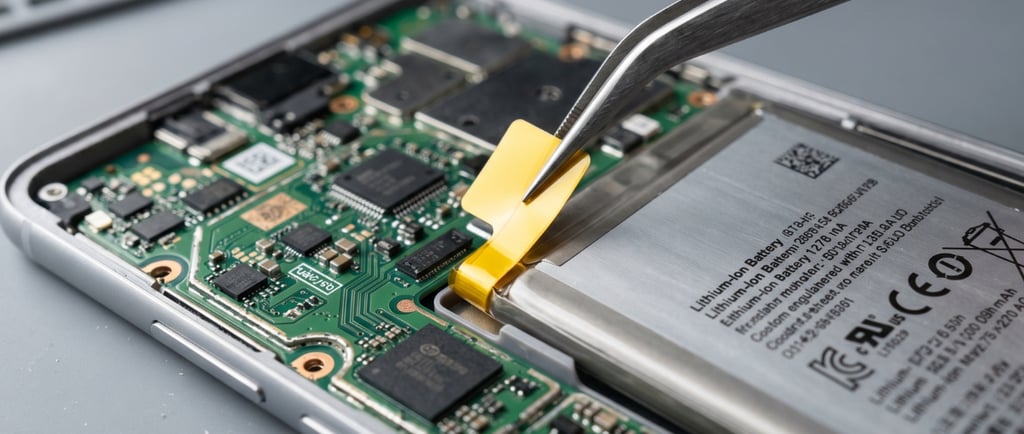
On February 18, 2027, the 42-month transition period for the key provisions of the Battery Regulation 2023/1542 will end. From that date, portable batteries in devices such as smartphones, laptops, or power tools will have to be readily removable and replaceable by the end-user. Conversely, batteries in light means of transport (LMT), such as e-scooters or e-bikes, must be designed to allow seamless replacement by independent professional repairers.
On paper, the European Union's primary objective is noble and strictly environmental: a drastic reduction in e-waste, extending the life cycle of devices, and implementing the principles of the Circular Economy. However, the business sector is facing a revolutionary shift in its sales model. Instead of buying a new device every two years, the consumer is expected to simply purchase a new battery.
A natural concern arises here: could the right to repair encourage manufacturers to use inferior, cheaper cells to artificially drive the sales of spare parts? The EU legislator has anticipated this risk. The new regulations go hand in hand with Ecodesign requirements, which impose strict performance standards. Batteries must not only be replaceable, but they must also retain a specific lifespan e.g., maintaining a minimum of 80% capacity after 800 charging cycles.
For R&D departments, this entails the necessity of designing an ideal product, which poses specific financial and technological challenges:
The need to create new injection molds for housings, moving away from cheap welding in favor of precise snap-fit mechanisms or seals.
Adding physical connectors, protective frames, and battery release mechanisms always consumes valuable additional millimeters inside the enclosure.
The obligation to maintain the availability of certified spare parts for several years after the production of a given model has ended. It is necessary to assume a highly probable scenario in which all these technological and logistical factors will impact the final manufacturing cost of the device.
Concerns are emerging in the market that EU manufacturers will lose their competitive edge against cheap electronics from Asia. Nothing could be further from the truth. The Battery Regulation 2023/1542 is based on the principle of a level playing field. The new design requirements apply to all devices placed on the European Union market, regardless of whether they were designed in Silicon Valley, assembled in Shenzhen, or manufactured in Europe.
The chain of responsibility under the new regulations:
Manufacturer (based in the EU): Bears full and direct responsibility for the design, production, and preparation of technical documentation proving that the battery can be readily replaced.
Importer (importing goods from outside the EU): Under EU market surveillance, the importer assumes the burden of responsibility. When bringing in electronics from China or the USA, it is you, as the Polish importer, who guarantees that the product meets the requirements. It is your door the inspector will knock on.
Distributor (e.g., retail chain, wholesaler): Has the obligation to verify the compliance of products and documents. A distributor who ignores glaring deficiencies also exposes themselves to sanctions.
What penalties apply for ignoring the new regulations?
The Battery Regulation itself does not stipulate fixed fine amounts, but instead obliges Member States to establish penalties that are "effective, proportionate, and dissuasive". In Poland, the enforcement of these provisions is handled by, among others, the Trade Inspectorate reporting to the Office of Competition and Consumer Protection (UOKiK), and the Voivodeship Inspectorates for Environmental Protection.
What financial penalties must businesses be prepared for?
Administrative and market penalties: Placing equipment on the market that does not comply with design requirements constitutes a violation of market surveillance regulations. Fines for each identified irregularity can amount to up to 100,000 PLN.
Environmental penalties: For gross negligence regarding the Act on Batteries and Accumulators, penalties can reach as high as 1,000,000 PLN.
Detention of goods at the border: This can occur if, during a shipment inspection, a customs officer identifies the absence of a CE mark, environmental labels, importer data, or a QR code.
When facing the risk of goods being detained at the border, your only "protective shield" is the product's technical file, substantiated by independent laboratory test reports.
From a technical perspective, how must R&D departments design devices to ensure these reports yield a positive outcome?
The EU legislator avoids imposing specific technological solutions. It dictates the outcome: the battery must be safely removable and reinstallable by the consumer, without causing permanent damage to the device.
Acceptable design methods:
Mechanical connectors and covers: Snap-fit mechanisms, slide-in battery modules, or sealed covers represent the safest path to achieving compliance.
Standard mounting screws: These are fully compliant, provided that removing them requires only commonly available tools.
Mounting adhesives and double-sided tapes: The European Union does not prohibit the use of adhesives. Thermal adhesives or mounting tapes are permitted, but strictly on the condition that specific release mechanisms are incorporated into the design, such as pull-tabs that break the adhesive bond when pulled.
A design will fail to comply with the Battery Regulation 2023/1542 if battery replacement requires the application of thermal energy (e.g., a heat gun), chemical solvents, or forceful prying of the cells, which introduces the risk of puncturing and thermal runaway.
From a legal standpoint, "easy replacement" must meet three strict criteria:
Commonly available tools
Replacement by the user must be achievable using basic tools, such as standard screwdrivers or tweezers, which the consumer already has at home or can easily purchase. If the R&D department insists on using proprietary screws, the manufacturer must provide the appropriate tool alongside the device or in the repair kit entirely free of charge.
Availability of spare parts on the open market
In accordance with Regulation (EU) 2023/1542, manufacturers must ensure the availability of batteries as spare parts for at least 5 years after placing the last unit of a given model on the market. These batteries must be offered at a reasonable and non-discriminatory price, at least to independent professional repairers. Depending on the device's design and the exceptions provided for in the regulations, this access may, but does not necessarily have to, extend to end-users as well.
Strict prohibition of software locks
The regulation categorically prohibits the cryptographic pairing of a battery's serial number to the motherboard. The device's software must not impede or degrade its performance (e.g., by displaying errors or blocking battery health statistics) if the consumer installs a compatible, certified battery from a third-party supplier.
The legislator provides for exemptions from the requirement of ready replacement by the end-user in situations where independent interference with the power supply would pose a safety hazard. Utilizing an exemption means, however, that ready replacement by an independent professional becomes the legal requirement.
In which situations can a manufacturer deny the consumer the option of independent replacement?
Devices operating in wet environments: This applies exclusively to equipment that is, by definition, regularly exposed to water (e.g., sonic toothbrushes, shower shavers, dive computers). A standard smartphone with an IP68 certification does not fall into this category. An error during the installation of a seal in such equipment would immediately lead to water ingress; therefore, replacement is left to professional repairers.
Medical and diagnostic equipment: Devices upon whose reliability the health or life of patients depends (e.g., defibrillators, in vitro diagnostic medical devices).
Hygiene-related devices (Washability): Equipment requiring a completely hermetic enclosure to maintain sterility, where assembly gaps would pose a risk of dangerous pathogen accumulation.
To utilize the "wet environment" exemption, you must prove its necessity. Laboratories assist in verifying these declarations by conducting rigorous IP rating tests, which substantiate the requirement for a hermetic enclosure.
New design challenges on the road to 2027
The approaching year 2027 and the rigorous requirements of the Ecodesign directive present R&D departments with unprecedented challenges that completely alter the design paradigm for new devices. The key task for engineers is no longer solely to guarantee the performance and safety of the equipment as it leaves the factory production line. The new regulations strictly demand the development of mechanical concepts that will maintain their original functionality and declared protection parameters even after the end-user has independently dismantled the enclosure and replaced the battery. The shift away from permanently bonded elements towards modular solutions compels manufacturers to conduct an in-depth revision of their existing design approach. Considering that in logistical and manufacturing realities, 2027 is essentially "tomorrow," new devices must be prepared and rigorously verified against these specific scenarios right now. Enterprises that ignore these guidelines expose themselves to severe sanctions from market surveillance authorities. Safeguard your business against operational risks and contact the experts at DLP-Poland.
Contact
+48 32 49 44 305
© 2025 DLP SP. Z O.O.


office@dlp-poland.com

ul. G. Morcinka 7D, 43-417 Kaczyce