


Cell vs. Pack, why brand-name cells do not exempt you from certification?
A guide for e-bike and light electric vehicle manufacturers in light of new regulations.
PUBLICATIONS
1/23/20264 min read
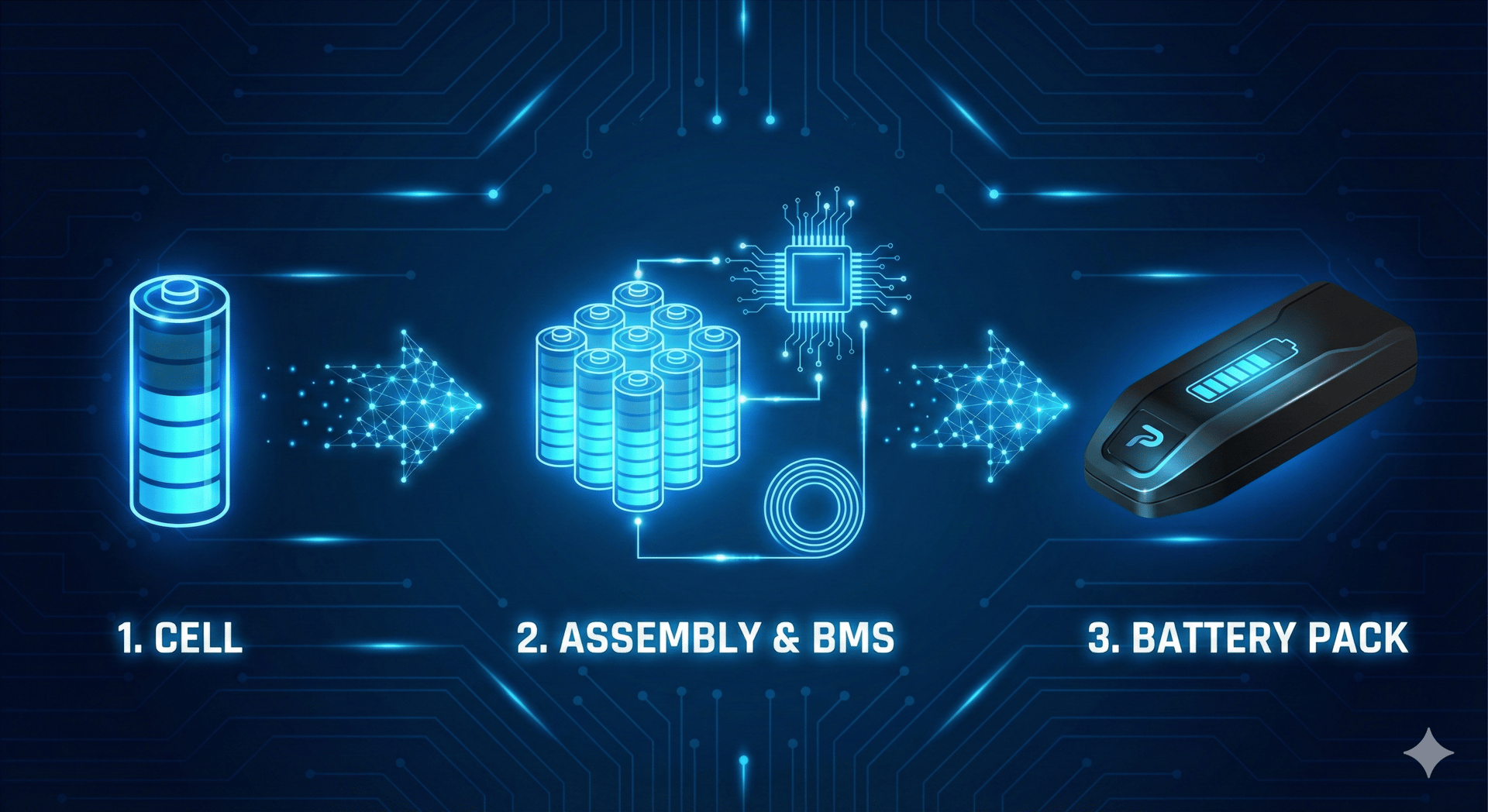
Many designers and manufacturers of e-bikes, scooters, or workshops producing custom battery packs proceed on the assumption, I use original Samsung, LG, or Panasonic cells that have all the certificates. I spot-weld them, add a BMS, and it is ready. My product is safe and legal.
Unfortunately, in light of the law and physics, this is one of the most dangerous myths in the industry. The new EU Battery Regulation and applicable laws treat the assembled pack as a completely new product.
We explain why a cell certificate does not transfer to the pack, what torture your battery must withstand in the laboratory, and where the fine line lies between a bicycle and a vehicle requiring homologation.
Cell vs. battery pack, the fundamental difference.
To understand the problem, we must define two concepts that the law treats separately:
Cell: This is the basic electrochemical element (e.g. popular formats like 18650, 21700, or prismatic and pouch cells). The cell manufacturer (e.g. Samsung, LG, Sony, Molicell, Panasonic) guarantees the safety of the chemistry inside the metal housing.
Pack/Battery: This is a system composed of many cells connected in series and parallel, equipped with protection and control electronics (BMS), wiring, a housing, and a thermal management system in the case of large applications such as ESS and automotive.
Why "certification mathematics" does not work?
The fact that a cell is safe does not mean that their combination is safe.
Thermal interference: The process of spot welding, welding cells generates heat, which can permanently damage the separators inside the cell or cause leaks.
Cell assembly: In so-called cell holders, improper fitting will cause the breakage of connection points between the cell and the frequently used nickel, copper-nickel strips.
BMS (Battery Management System): This is a key safety element. The cell certificate says nothing about whether your BMS will work correctly and cut off power during, for example, overcharging, overheating.
Short circuit risk: In a pack, cells are packed tightly. Vibrations, e.g. while riding a bicycle, can wear through the insulation and lead to a short circuit inside the battery, even if a single cell is functional.
The "Custom E-bike" trap and regulations in Poland (20 vs 25 km/h)
For companies assembling their own packs, vehicle classification is key. It is worth remembering that Polish regulations (since May 2021) introduced an important distinction between a bicycle and a scooter.
Power-assisted bicycle (EPAC / Pedelec)
The vehicle does not require homologation if it meets the conditions of the EN 15194 standard and the Road Traffic Law: Motor power: max 250 W. Assistance cuts off after exceeding 25 km/h. Assistance operates only while pedaling.
Electric scooter (e-scooter) in Poland
Note here! In Poland, the speed limit for scooters is lower than the EU standard for bicycles.
Maximum design speed: 20 km/h (and not 25 km/h!).
If your scooter reaches 25 km/h, in light of Polish regulations, it may be considered a moped requiring homologation and registration.
Speed Pedelec and powerful "Customs" (Category L)
If your vehicle exceeds the above parameters (e.g. a bicycle traveling at 45 km/h or a scooter above 20 km/h), it becomes a Category L vehicle (moped). Consequences: Mandatory Type Approval and battery tests compliant with UNECE regulations.
The torture lab, or what tests should your pack undergo?
Before a battery manufacturer issues a CE declaration of conformity, it must pass tests according to standards UN 38.3 (transport), EN 62133-2, or also EN 50604-1 in the case of electric bicycles, we subject it to a series of tests simulating the worst real-life scenarios. Your pack must survive them without fire, explosion, and leakage.
Here is what your battery must be physically resistant to:
I. Mechanical resistance, meaning accident and transport simulation
Vibration Test: The battery is shaken for hours in different planes. This simulates years of riding on cobblestones or transport in a truck. The test checks whether welds break and screws loosen.
Shock Test: Sudden impacts of great force. This simulates hitting a pothole, the fall of a courier package, or a collision.
Crush/Impact Test: One of the most important tests. It simulates a traffic accident in which the structure of the bicycle or scooter undergoes deformation, crushing the battery. The housing and cells must withstand this without ignition.
II. Environmental resistance, meaning weather and airplanes
Thermal Cycling: We cool the battery to -40°C and then quickly heat it to +72°C. The procedure is repeated many times. This checks the tightness of seals and the behavior of chemistry inside cells during extreme temperature changes.
Altitude Simulation: The battery is placed in a vacuum chamber where the pressure is reduced to 11.6 kPa, simulating conditions at an altitude of approximately 15,000 meters.
III. Electrical safety. Does the BMS work?
External Short Circuit: In test procedures, the poles of a fully charged battery are intentionally shorted. A correctly programmed BMS must detect the current surge and disconnect the circuit in a time counted in milliseconds. If the protection does not work, the short circuit energy will lead to a thermal runaway, rapid outgassing, and consequently battery ignition.
Overcharge: We apply voltage and current higher than recommended. The test checks what happens when a user connects a broken or non-original charger.
Standards checklist for your product
As the creator of a battery pack, you are legally responsible for passing these tests for the finished product. The bicycle standard EN 15194 is no longer a "lonely island", it forces the application of specialized battery standards.
UN 38.3: Necessary minimum for shipping (transport). Without this, the courier will not accept the package.
EN 50604-1: Key standard for batteries for light electric vehicles (bicycles, scooters). It is much more mechanically rigorous than standards for consumer electronics.
IEC 62133-2: General standard for the safety of portable batteries.
Electromagnetic Compatibility (EMC): A battery with electronics cannot interfere with the operation of other devices and be susceptible to interference.
Legal sources for verification
Don't take our word for it, check the regulations at the source:
Regulation (EU) 2023/1542 (New Battery Regulation).
Road Traffic Law Act (Definitions of electric scooter and bicycle).
Standard PN-EN 15194:2017 (Cycles, Electrically power assisted cycles, EPAC).
Creating your own battery packs is a manufacturing process, not just assembly. Using brand-name cells is a great start, but only 10% of certification success.
At DLP Poland, we help navigate this labyrinth. We verify the documentation of your cell suppliers, conduct tests in safe laboratory conditions, and advise on how to legally introduce e-mobility batteries to the market.
Contact
+48 32 49 44 305
© 2025 DLP SP. Z O.O.


office@dlp-poland.com

ul. G. Morcinka 7D, 43-417 Kaczyce