

CE Certification Step-by-Step: How to Launch Your Product Without Breaking the Bank
CE Marking: A Passport to Profits or a Ticket to Bankruptcy? Avoiding the Mistakes That Sink Importers
PUBLICATIONS
12/1/20255 min read
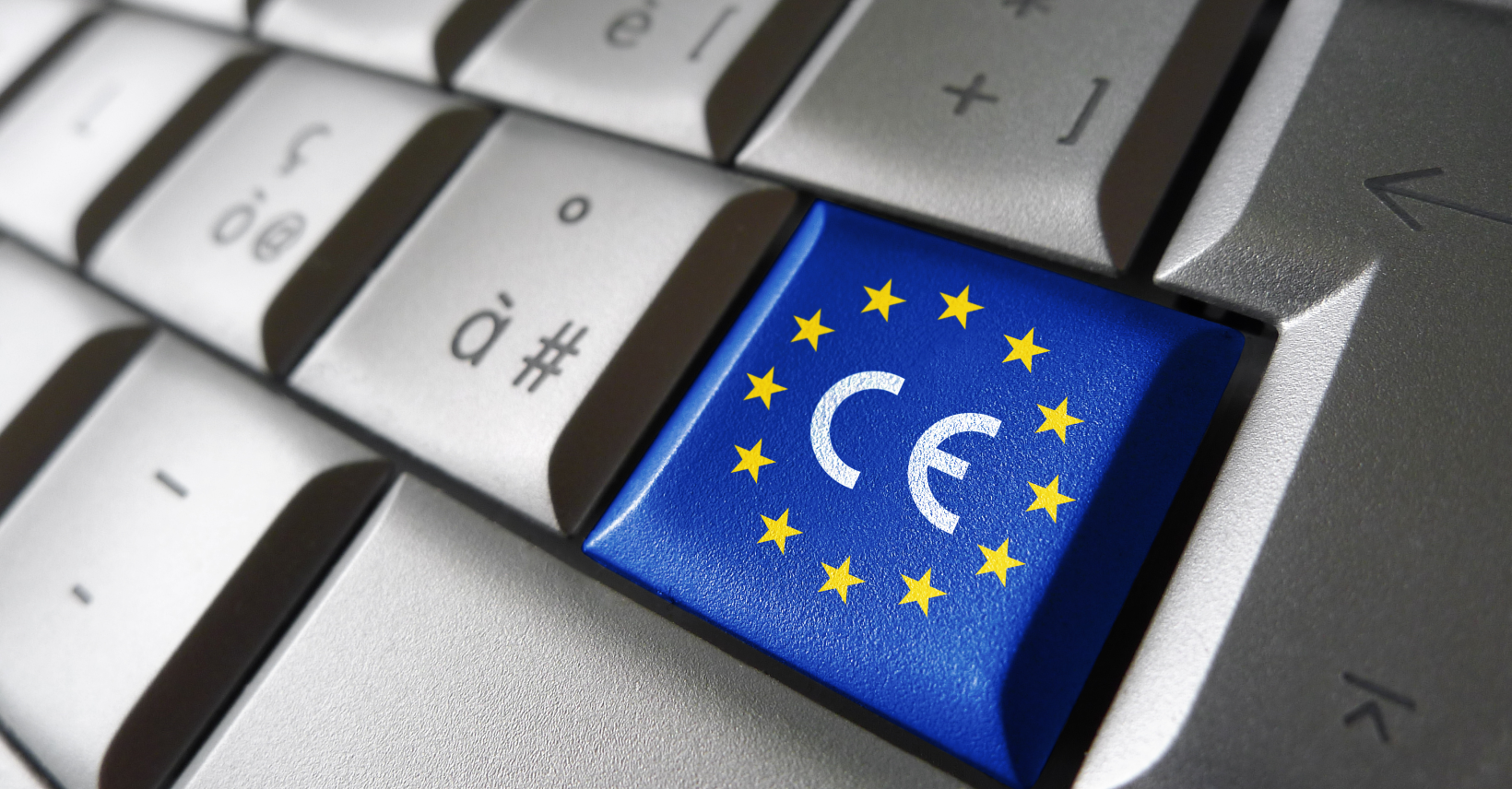
You have a finished product. It’s innovative, refined, and visually stunning. You can already see the sales charts climbing. But there’s one last obstacle in your path: EU bureaucracy and the mysterious CE Marking.
Many entrepreneurs treat CE as a mere sticker, a formality to "get out of the way" so the customer stops asking questions. This is a mistake that can cost you your company.
CE Marking is not a sticker. It is a legal declaration where you state: "I take full responsibility that this product will not kill or injure anyone." It is your legal armor. If it’s solid, it protects your brand and your profits. If it’s made of cardboard, the first market inspection will sweep you off the market.
You might be asking yourself: "Does this really apply to me, or just to massive corporations?" The answer is simple: if you want to sell legally in Europe, this is your "to be or not to be."
Here is how to navigate the process safely, step-by-step.
5 Steps to CE Marking. Your Strategic Roadmap
Bureaucracy can be paralyzing, but don’t view this as a government whim. Treat these five steps as the manual for your financial security.
Step 1: Diagnose the Requirements. Where do the traps lie?
Before you spend a single dollar on production, you must know which laws apply to your goods. Misjudging this at the start will cause the entire project to collapse. It’s like building a house without checking the soil. You must identify which New Approach Directives apply to you.
What does this mean in practice?
Is it a Machine? (Machinery Directive): If it moves and has a motor, you must guarantee it won't sever a customer's finger.
Is it Powered by Electricity? (LVD – Low Voltage Directive): This is your insurance against a bedside lamp starting a fire in a customer’s bedroom.
Does it Emit a Signal? (RED/EMC): This guarantees your toy won't interfere with a grandmother's pacemaker or a neighbor's Wi-Fi.
What about Batteries? (EU Battery Regulation): A new 2025 requirement where many fail. If you don't account for recycling and sustainability, your goods may be seized at the border.
Step 2: Choose the Judge (Conformity Assessment Procedure)
Now that you know the requirements, who verifies them? The EU offers choices based on risk (known as Modules). This is a business decision based on trust and liability.
Low Risk (Module A): You perform a self-assessment. It’s fast and cheap, but remember, you are both the judge and the defendant. In the event of an accident, the full weight of responsibility rests solely on your shoulders.
High Risk: You must hire a Notified Body. These are external, third-party experts. They cost more, but they provide a comprehensive liability shield, their certificate is a powerful argument in court that you exercised due diligence.
Step 3: Test and Verify. Your Alibi
In business, as in court, evidence matters more than promises. You must prove the product is safe. The good news? The EU provides a "cheat sheet": Harmonized Standards.
You don’t need to reinvent the wheel. If your product passes tests according to a specific standard (e.g., for toys), you gain a "presumption of conformity." When an official asks, "Why do you believe this is safe?" you simply lay the test report on the table and end the discussion.
Step 4: The Golden Book. Technical Documentation
This is where 80% of importers fail. Testing is one thing; paperwork is another. Your Technical Documentation (TD), or Technical File, is your insurance policy.
When market surveillance authorities knock on your door (and they can do so for up to 10 years!), they won't ask to see the product; they’ll ask for the Documentation.
You must keep it for 10 years.
It must be complete (designs, schematics, risk assessments).
No Technical File = Illegal Product, even if it functions perfectly.
Step 5: The Grand Finale. Declaration and CE Marking
This is the moment of truth. You issue the EU Declaration of Conformity (DoC) and apply the CE mark. Remember: this isn't an autograph. It is a legal document where you swear by your company's assets that you have fulfilled all formalities.
Only now can your product legally leave the warehouse. But who is responsible for it next?
Who Pays for What? Your Role in the Supply Chain
You might think: "I’m just a trader; I buy and sell." EU law sees it differently. Your responsibility (and risk of penalties) depends on your role.
A. The Manufacturer: The Creator and Main Target You are at the top of the pyramid. You sign the Declaration. If something goes wrong, market oversight comes for you first. Your duty is to maintain perfect records for a decade.
B. The Importer: The Border Guard (Beware of the Trap!) Are you sourcing goods from China or outside the EU? Watch out. By introducing goods from outside the EU, you legally assume the obligations of the manufacturer.
You cannot simply "trust" the factory in Asia.
You must verify if they have genuine certificates (not "Photoshop" versions).
You must place YOUR contact details on the product. If you don't, you remain invisible to the customer but highly visible to inspectors, who will issue a heavy fine.
C. The Distributor: The Last Line of Defense You don’t have to perform the tests, but you must keep your eyes open. You are the filter. You check: Is there a CE mark? Is there an instruction manual in the local language? If you sell a product missing these elements, you will get the fine during a shop inspection.
What Does a Mistake Cost? (And it’s not just the fine)
Administrative fines hurt, but they can be earned back. The real cost to your business is a loss of trust that you may not survive.
The "Official" Price List:
Up to $25,000 (100,000 PLN) in administrative fines for missing paperwork.
Mandatory Market Recall: You must buy back the goods from customers and dispose of them, this can bankrupt a company in a single day.
The "Market" Price List (Real-Life Stories):
Electric Shock: An importer of cheap chargers ignored the LVD Directive. Result? A burned customer, a PR nightmare in the media, and a warehouse full of unsellable e-waste.
Toxic Toys: In 2024, there was a major scandal regarding dolls containing phthalates (carcinogenic chemicals). Imagine your brand hitting the headlines of parenting portals as the one that "poisons children." You cannot rebuild that image.
Missing Address: A company was growing fast but forgot to put the importer's details on the packaging. The product was safe, but formally defective. Result? A sales ban on the entire container until thousands of units were relabeled. The operational cost ate the entire quarter's profit.
Build on Rock, Not on Sand
Entering the EU market is a high-stakes game. CE is not a bureaucratic whim; it is the foundation of your customer's trust in your brand.
You can try to navigate the jungle of directives alone, risking that you miss one crucial paragraph. Or, you can build this process on the solid mortar of expert knowledge.
Do you have doubts about whether your Technical Documentation is a "Golden Book" or a "Ticket to Trouble"?
Don’t guess. Verify. Take advantage of a free consultation. We will help you turn a bureaucratic obligation into your competitive advantage.
Contact
+48 32 49 44 305
© 2025 DLP SP. Z O.O.


office@dlp-poland.com

ul. G. Morcinka 7D, 43-417 Kaczyce