


Battery Passport. An Implementation Compendium for Businesses
The new EU regulation concerning batteries and waste batteries is a revolution for the automotive, energy, and electronics sectors. We are entering an era where product data becomes just as crucial as the physical product itself. The following article serves as a detailed guide to the regulations, obligations, and technical aspects of implementing the Battery Passport.
PUBLICATIONS
2/19/20264 min read


The introduction of the Battery Passport is a direct implementation of the European Green Deal and the Circular Economy action plan. The traditional "produce – consume – dispose" model is being replaced by a transparent, closed-loop model.
What is the Battery Passport?
In technical and legal terms, the Battery Passport is a digital data record, a so-called "Digital Twin" of the physical device. It is a unique set of information assigned to each individual battery (not just the model type) placed on the market in the European Union.
The main objective of the system is full traceability. The passport is designed to answer three key questions:
Where do the raw materials come from? (Ethical mining, due diligence).
What is the environmental impact? (Manufacturing carbon footprint).
What should be done with the battery at its end-of-life? (Dismantling instructions and chemical composition for recyclers).
Legal Basis and Timeline
The legal foundation is the Regulation (EU) 2023/1542 of the European Parliament and of the Council. This is a legal act directly applicable in all Member States, without the need for implementation into national laws.
Key Dates and Status of Obligations:
From the perspective of date February 18, 2026, we are at a critical juncture in the implementation of the regulations:
February 18, 2025 (OBLIGATION ALREADY ACTIVE): For a year now, there has been a requirement to include a carbon footprint declaration for electric vehicle (EV) batteries. Every EV battery placed on the market must have technical documentation confirming its carbon footprint.
February 18, 2026: Originally, it was assumed that around this time, the carbon footprint declaration requirement would apply to rechargeable industrial batteries (with a capacity above 2 kWh). However, the regulations stipulate that this requirement enters into force on February 18, 2026, OR 18 months after the entry into force of the delegated act (specifying the exact calculation methodology by the European Commission), whichever is later. Due to the ongoing work on the methodology, the actual obligation for industrial batteries is being postponed.
February 18, 2027 (FINAL DEADLINE): This is the date for the full implementation of the Battery Passport. From this day forward, every new battery (EV, industrial >2kWh, LMT) must feature a physical QR code on its casing, linking to an active, digital data record. Without this, the product will not be permitted on the EU market.
Who and What Does It Affect? Device Classification
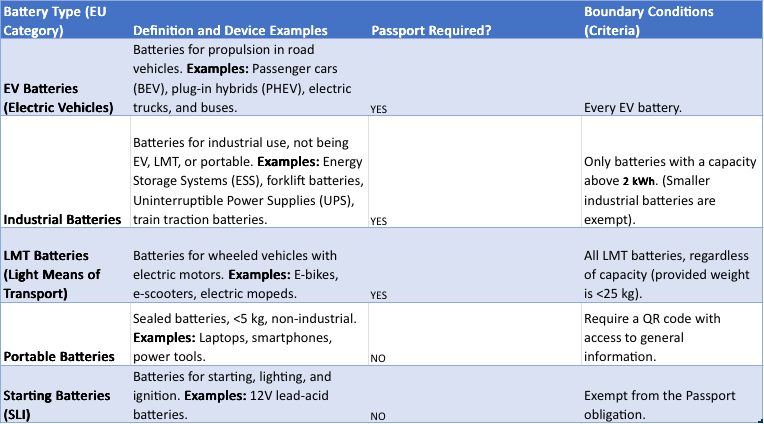
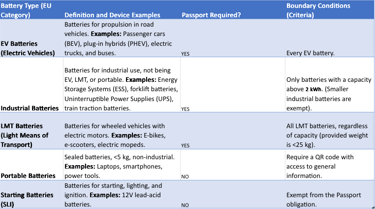
Not every battery requires a passport. The regulations precisely define the product groups subject to this requirement, excluding, for example, small portable batteries or classic starting (SLI) batteries in combustion engine cars.
Table 1: Classification of Devices and Battery Types Subject to the Passport Requirement
Scope of Information in the Battery Passport
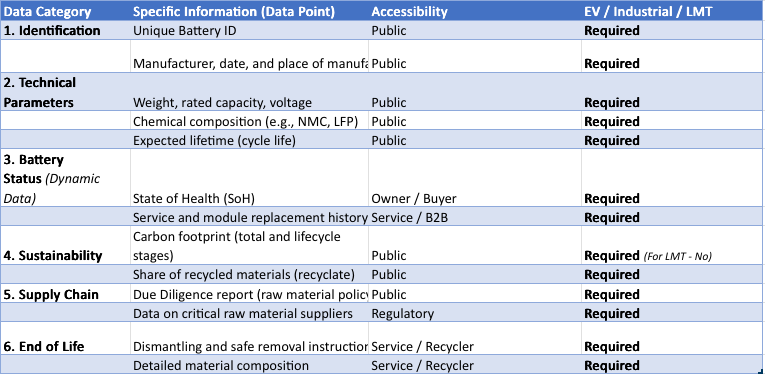
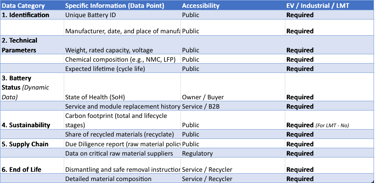
The Battery Passport operates on an access hierarchy. A consumer sees different data than a regulatory body or a recycler. The system protects trade secrets while simultaneously sharing key environmental data.
Access Levels:
Public: Accessible to anyone upon scanning the QR code.
Regulatory: Accessible to market surveillance authorities and the European Commission.
B2B / Service: Accessible to entities with a "legitimate interest" (repair services, recyclers).
Table 2: Scope of Data in the Passport (Data Points)
Obligations vs. Company Size (SMEs vs. Corporations)
The responsibility for the passport rests with the entity placing the battery on the market for the first time in the EU (this could be the manufacturer, importer, or private label distributor). However, the regulation provides significant exemptions for the SME sector regarding supply chain reporting.
Table 3: Differentiation of Obligations by Company Size
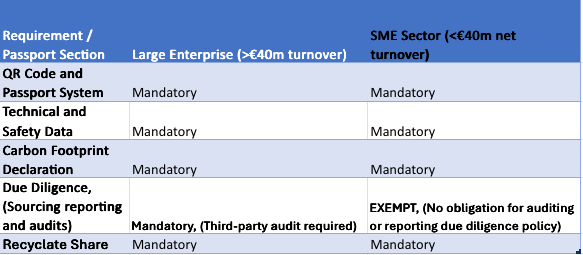
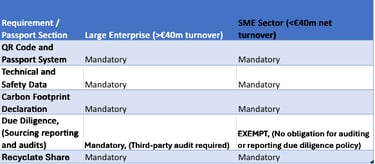
Conclusion: Small businesses must still create a passport and calculate their carbon footprint, but they are exempt from the costly process of auditing mines and refineries within their supply chain.
Technical and Implementation Aspects (IT)
The Battery Passport is an IT challenge built on a decentralized model. There is no single central EU database storing all the files.
Architecture: Data is physically hosted on the manufacturer's (or their operator's) servers. The European Commission only provides a central indexing registry.
QR Code: Must be permanently affixed to the battery (engraved/printed, resistant to external factors), complying with the ISO/IEC 18004 standard.
Data Lifecycle: The system must allow for data updates (e.g., during repair) and the creation of a new passport when a battery is repurposed (e.g., from an EV to an energy storage system).
Interoperability and Standards: To ensure consistency across the European market, data must be shared using open standards.
Data Language: The JSON-LD (JavaScript Object Notation for Linked Data) standard is mandated, enabling machine-readable data.
Exchange: It is recommended to rely on the Data Spaces ecosystem, such as Catena-X. This allows a recycler in any EU country to read dismantling instructions using standardized software, without needing to log into the proprietary portals of each individual manufacturer.
Action Plan. Where to begin?
One year until full implementation (February 2027) is very little time in the industrial sector. Companies that have not yet started digitizing their products risk losing the ability to sell on the EU market.
3 Critical Steps to Take Right Now:
Supply Chain Mapping (Tier-N): Identify the origin sources of your components. Without this, you cannot precisely calculate the carbon footprint, which is required for industrial batteries as of today.
LCA Methodology (Carbon Footprint): Ensure your calculations comply with the EU's JRC/PEFCR guidelines, not just general ISO standards.
Digital Backbone: Begin collecting static data (safety data sheets, instructions) in a structured digital format, ready to be exported to JSON-LD.
The Battery Passport is not just bureaucracy, it is a tool that will organize the market and eliminate entities offering products of unknown origin and poor quality.
Contact
+48 32 49 44 305
© 2025 DLP SP. Z O.O.


office@dlp-poland.com

ul. G. Morcinka 7D, 43-417 Kaczyce